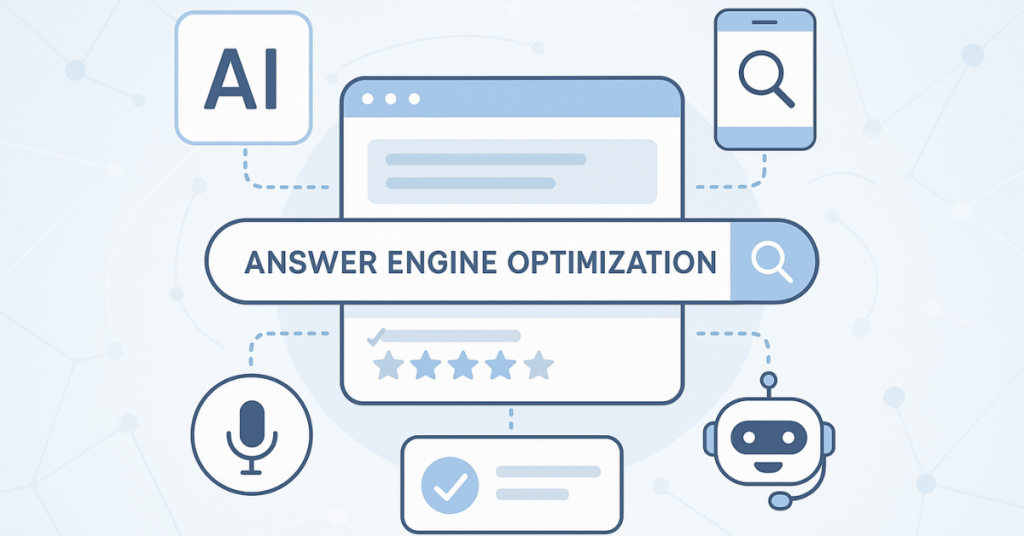
The way people search for information is changing rapidly. For years, businesses have focused on Search Engine Optimization (SEO) to improve their visibility on Google and other search engines. Today, users increasingly expect something different: not just a list of links, but a direct, useful answer.
AI assistants, conversational search tools, voice assistants, and AI-powered search experiences are accelerating this shift. As a result, a new discipline has become increasingly important: Answer Engine Optimization (AEO).
What Is AEO?
Answer Engine Optimization (AEO) is the practice of creating and structuring content so that search engines and AI-powered systems can easily understand it and use it to answer users’ questions.
Traditional SEO often focuses on helping a webpage rank prominently in search results. AEO goes a step further by asking:
Can an answer engine understand our content well enough to use it when answering a user’s question?
An answer engine may include traditional search features that provide direct answers, voice assistants, conversational AI systems, and AI-powered search experiences.
For example, instead of searching: “best project management software”
A user might ask: “What project management software is best for a 20-person marketing team that needs automation and client reporting?”
The second query is more conversational and specific. AEO helps businesses create content capable of addressing these kinds of questions clearly and accurately.
AEO vs. SEO: What’s the Difference?
AEO does not necessarily replace SEO. Instead, it builds upon many of the same fundamentals.
SEO traditionally aims to improve factors such as search rankings, organic traffic, keyword relevance, backlinks, technical performance, and user experience.
AEO places greater emphasis on answer clarity, context, structure, authority, and machine readability.
Example of a page explaining Nursing Programs.
An SEO-oriented approach might target the keyword “nursing programs near me.”
An AEO-oriented approach for a nursing programs webpage might organize the content around questions such as:
- What types of nursing programs are available?
- How long does it take to complete a nursing degree?
- What are the admission requirements for a nursing program?
- What is the difference between an ADN, BSN, and RN-to-BSN program?
- How much does nursing school cost, and is financial aid available?
- Can I complete a nursing program online or part-time?
- What career opportunities are available after completing a nursing program?
This question-and-answer structure helps prospective students find relevant information while making the content easier for AI-powered search engines to understand and potentially feature in generated answers.
Why Is AEO Becoming Important?
1. Search behavior is becoming conversational
People increasingly search using complete questions rather than short keyword phrases. Voice interfaces and conversational AI have made natural-language queries feel normal.
Instead of typing “CRM small business price,” someone may ask:
“What’s an affordable CRM for a small business with five salespeople?”
Content designed around real questions is better positioned to address this behavior.
2. AI is changing how information is discovered
Search experiences increasingly summarize and synthesize information for users. In some situations, users may receive the information they need without following the traditional pattern of clicking through several search results.
That changes the visibility challenge for brands.
Being discoverable is no longer only about securing a high-ranking link. Businesses increasingly need their information to be clear, credible, accessible, and easy for machines to interpret.
3. Users want answers faster
People rarely want to dig through a long article just to find one fact. Good AEO content surfaces important information quickly while still providing deeper explanation for readers who need it.
A strong content structure might therefore look like:
Question → concise answer → supporting explanation → evidence → related questions
This format benefits both human readers and automated systems.
4. Authority and trust matter
Answer engines need reliable information. Organizations that consistently publish accurate, well-supported, current content have a better foundation for becoming trusted sources.
That means AEO is not simply about inserting keywords or formatting pages differently. It encourages businesses to demonstrate expertise through original insights, credible sources, transparent authorship, accurate product information, and regularly updated content.
How Can Businesses Optimize for AEO?
Effective AEO begins with understanding what customers actually want to know.
Create content around real questions
Research questions customers ask during different stages of their journey. Sales conversations, customer-support tickets, community discussions, search data, and FAQs can all reveal valuable topics.
Instead of creating a generic article titled “Cybersecurity Solutions,” for example, a company might address specific questions such as:
“How much cybersecurity does a small business need?”
Provide the answer early
Avoid forcing readers to navigate several paragraphs before reaching the main point.
When possible, answer the core question directly near the beginning and then provide additional context, examples, evidence, and qualifications.
Structure information clearly
Good formatting helps readers scan information and helps systems understand relationships between topics.
Use descriptive headings, concise paragraphs, lists where appropriate, comparison tables, FAQs, definitions, and logically organized sections.
Build topical authority
Rather than publishing isolated articles around unrelated keywords, develop clusters of useful content around subjects in which your organization has genuine expertise.
For example, a financial software company could build comprehensive resources covering invoicing, expense management, cash-flow forecasting, accounting automation, financial reporting, and related questions.
Together, these resources create stronger contextual signals than a collection of disconnected articles.
Use structured data where appropriate
Schema markup and other forms of structured data can help search engines understand what information on a page represents, such as products, organizations, events, articles, or other entities.
Structured data is not a guarantee that content will appear in an AI-generated answer, but good technical structure can make content easier for search systems to interpret.
Keep information accurate and current
Outdated pricing, statistics, product features, regulations, and recommendations can quickly undermine credibility.
Content teams should periodically review important pages, update outdated claims, correct broken links, and clearly indicate relevant publication or update dates.
Ultimately, the goal of AEO is straightforward:
Don’t optimize only to be found. Optimize to be understood, trusted, and useful enough to become part of the answer.