Choosing the right paid media strategy is one of the most important decisions in digital advertising. Two of the most common approaches, Google Display Network (GDN) and programmatic advertising, can both help brands reach new audiences, but they operate very differently.
While both deliver display ads across the web, they differ significantly in inventory access, targeting capabilities, reporting, automation, and scalability. Understanding those differences can help marketers invest their budgets more effectively and maximize campaign performance.
Let’s break it down.
What Is the Google Display Network (GDN)?
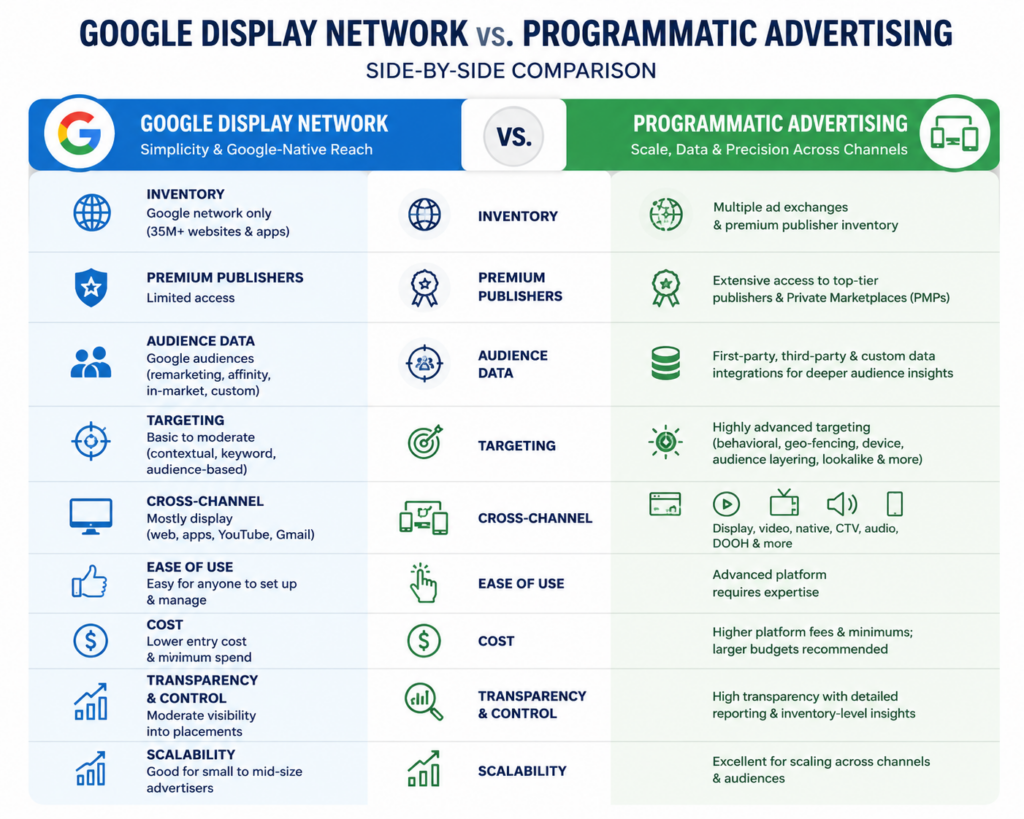
The Google Display Network is Google’s advertising network that allows advertisers to place display ads across millions of websites, mobile apps, Gmail, and YouTube using the Google Ads platform. Google reports that Display campaigns can reach users across more than 35 million websites and apps, making it one of the largest display advertising ecosystems available.
Because GDN is managed directly within Google Ads, it’s often the first step businesses take into display advertising.
Pros of Google Display Network:
- Low barrier to entry – No additional software or platform licenses required.
- Easy campaign setup – Launch campaigns quickly within Google Ads.
- Google audience data – Access remarketing, affinity, in-market, and custom audiences.
- Contextual targeting – Show ads based on page content, keywords, or topics.
Cons of Google Display Network:
- Limited reach: Restricted to websites and apps in Google’s network.
- Basic targeting: Lacks the depth of data-driven segmentation and third-party audience targeting available in other platforms.
- Limited premium inventory: May miss out on top-tier publishers or niche channels.
- Lack of Transparency: Less transparency and control over inventory buying than many programmatic platforms.
Best for:
- Small-to-mid-sized businesses
- Quick-turn or location-based campaigns
- Brands with limited budgets
- Remarketing campaigns
- Businesses already investing heavily in Google Search or YouTube Ads
What Is Programmatic Advertising?
Programmatic advertising is the automated buying and selling of digital advertising inventory through Demand Side Platforms (DSPs) such as The Trade Desk, Google Display & Video 360 (DV360), StackAdapt, Amazon DSP, and others.
Instead of purchasing inventory from one advertising network, programmatic platforms access multiple ad exchanges simultaneously, allowing advertisers to bid on impressions across thousands of publishers in milliseconds through Real-Time Bidding (RTB).
This creates significantly greater scale, flexibility, and targeting precision than a single ad network can provide.
Pros of Programmatic:
- Massive reach: Access to inventory beyond Google, including premium publishers.
- Advanced targeting: Behavioral, geo-fencing, household targeting, device targeting, audience layering, third-party audiences, and more.
- Cross-channel capability: Run ads across display, video, native, audio, in-game, CTV, DOOH and more.
- Real-time bidding (RTB): Efficient pricing and optimized placements.
Cons of Programmatic:
- Complex to manage: Requires expertise and technical setup.
- Platform fees: Often involves higher minimums and added costs.
- Learning curve: Harder for in-house teams without prior experience.
Best for:
- Larger budgets
- Brands focused on scale, efficiency, and performance
- Sophisticated advertisers or those working with agencies
- Full-funnel marketing strategies
- Brands focused on long-term growth and efficiency
What If You’re Working with a Media Buying Agency?
When you work with a media buying agency, you’re tapping into:
- Expertise in advanced DSPs (e.g., The Trade Desk, DV360 & more)
- Data partnerships for audience targeting
- Cross-channel media orchestration
- Ongoing optimization by skilled traders and analysts
Suddenly, the complexity and cost that might hold back in-house teams are no longer a concern. Your agency partner handles targeting, creative, bidding strategies, viewability monitoring, and performance reporting.
Google Display Network is still a valuable tool. It can be used to:
- To complement search or YouTube campaigns
- For remarketing to Google audiences
- When targeting specific placements or quick-launch campaigns
Both Google Display Network and programmatic advertising are powerful digital advertising solutions, but they solve different business challenges.
If your goal is simplicity, speed, and cost-effective display advertising, Google Display Network is an excellent starting point.
If your objective is greater scale, advanced audience targeting, premium inventory, omnichannel reach, and data-driven optimization, programmatic advertising provides capabilities that extend well beyond Google’s ecosystem.
For many organizations, the most effective paid media strategy isn’t choosing one over the other—it’s understanding how each platform supports different stages of the customer journey and using them together to create a more comprehensive digital marketing strategy.
Ready to Build a Smarter Media Strategy?
Whether you’re launching your first display campaign or scaling an enterprise-level omnichannel strategy, Media Placement Services can help you identify the right mix of Google Display, programmatic advertising, paid search, connected TV, video, and social media to maximize your marketing investment.
Contact Media Placement Services today to build a customized paid media strategy that reaches the right audience, in the right place, at the right time.